|
Welcome back
friends of Full Quiver Farm!
Winter 2005
This past year was one
filled with many blessings and challenges. Through it
all, we continue to trust in our Provider for His
direction and mercy.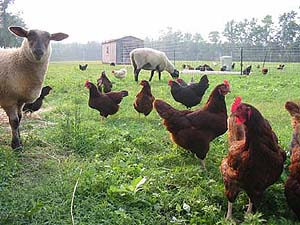
This was our first year with the all-new Suffolk
Farmers Market. It was a great success in that we
found many of you there at the market. We're planning
on returning this year, and can't wait to see how
everyone is doing. Our biggest challenge was trying to
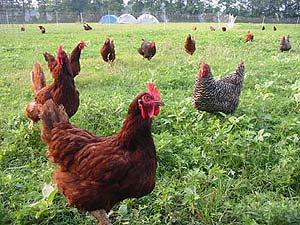
keep from selling out of our famous Country Brown
Eggs. This year we hope to solve this with a whole new
batch of pullets. (A pullet is a hen under a year
old). We ordered 120 this fall and they should be
ready to start laying in earnest by the time the
Farmers Market gears up.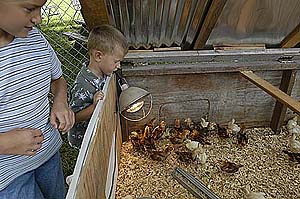 It takes pullets about 21 weeks before they lay that
first egg. After that they'll average one a day for
most of the season, until the days get shorter in the
fall.
It takes pullets about 21 weeks before they lay that
first egg. After that they'll average one a day for
most of the season, until the days get shorter in the
fall.
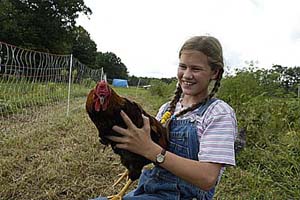 Morgan,
our oldest (13yrs), is taking on the eggs as her
enterprise this year. She tended them most of last
year, and is ready to do everything this year. She's
excited about it and would love to talk to you about
them at our booth at the market. Morgan,
our oldest (13yrs), is taking on the eggs as her
enterprise this year. She tended them most of last
year, and is ready to do everything this year. She's
excited about it and would love to talk to you about
them at our booth at the market.
Broilers will continue to
be our centerpiece product this year. We will continue
to have monthly farm pickup days (see schedule).
Please remember to pre-order for the pickup days. As
usual, we'll have bro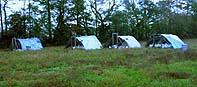 ilers available at the
farmers market. Some of you will remember that severe
heat was a problem two years ago and partly due to our
low shelter design. Our new portable "hoop" shelter
design this past year took care of this problem by
venting heat upward and encouraging good air-flow. ilers available at the
farmers market. Some of you will remember that severe
heat was a problem two years ago and partly due to our
low shelter design. Our new portable "hoop" shelter
design this past year took care of this problem by
venting heat upward and encouraging good air-flow.
Lilly, the cow.
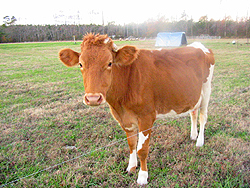 This winter we added a family
dairy cow, Lilly. You just can't beat an ice cold
glass of milk that you personally extracted from your
own cow just a few hours earlier. Just make sure and
wash it down with some of Katie's (12yrs) home-made
brownies! Lilly has quite a personality. She is the
source of many humorous stories. Here's one from
shortly after we got her… We were getting her used to
coming into the milk parlor in the morning and
evening. This is before we learned that cows don't
like change. They like everything to be in the same
place and everything done in the same order, at the
same time. We went out to the pasture to fetch her,
and didn't realize that someone had left a green
garden hose running right across in front of the door
to the milk parlor. She was walking along and suddenly
jerked to a stop, staring at the hose, as if to say,
"well, what do I do now?" I knew that if I tried to
move the hose that it would startle her even more. We
were finally able to coax her timidly in.
Unfortunately, Bess, our family dog, decided to come
sniffing about her hind feet, when wham! This winter we added a family
dairy cow, Lilly. You just can't beat an ice cold
glass of milk that you personally extracted from your
own cow just a few hours earlier. Just make sure and
wash it down with some of Katie's (12yrs) home-made
brownies! Lilly has quite a personality. She is the
source of many humorous stories. Here's one from
shortly after we got her… We were getting her used to
coming into the milk parlor in the morning and
evening. This is before we learned that cows don't
like change. They like everything to be in the same
place and everything done in the same order, at the
same time. We went out to the pasture to fetch her,
and didn't realize that someone had left a green
garden hose running right across in front of the door
to the milk parlor. She was walking along and suddenly
jerked to a stop, staring at the hose, as if to say,
"well, what do I do now?" I knew that if I tried to
move the hose that it would startle her even more. We
were finally able to coax her timidly in.
Unfortunately, Bess, our family dog, decided to come
sniffing about her hind feet, when wham! 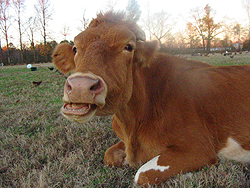 Fast as lightening, out flashed
a kick that caught the dog right in the head. To say
the least, everyone was quite nervous after this.
(Bessie the dog was fine, by the way). As I remember
it, this was one of the few evenings that Lilly kicked
over the milk about halfway through. So we learned our
lesson, don't leave hoses laying around, and Bessie
the dog tucks her tail whenever Lilly comes around.
Lilly has turned out to be a great milker and has a
great disposition, as long as things stay predictable.
She gives around 5 gallons a day. We've got real cream
for our coffee and delicious butter. We're about to
try our hand at cheese making. We'll let you know how
that goes. Fast as lightening, out flashed
a kick that caught the dog right in the head. To say
the least, everyone was quite nervous after this.
(Bessie the dog was fine, by the way). As I remember
it, this was one of the few evenings that Lilly kicked
over the milk about halfway through. So we learned our
lesson, don't leave hoses laying around, and Bessie
the dog tucks her tail whenever Lilly comes around.
Lilly has turned out to be a great milker and has a
great disposition, as long as things stay predictable.
She gives around 5 gallons a day. We've got real cream
for our coffee and delicious butter. We're about to
try our hand at cheese making. We'll let you know how
that goes.
Right now we're not
offering milk, although we're looking into it. Please
let us know if you would be interested. If we did, it
would be contract based, so there would be a
commitment required. We would also need to work out
pick-up logistics. All this is in the planning stages
right now so we'd love your input.
Full Quiver
Farm Fun Facts
Did you
know...
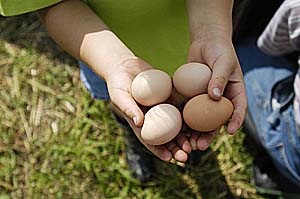
The average hen will lay between 200 to 300 eggs a
year!
Do you need a
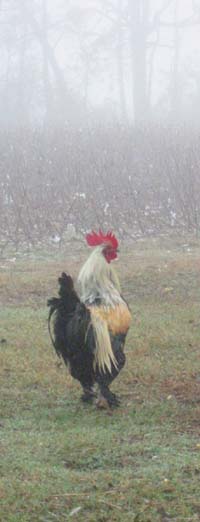
rooster to get eggs?
You only need a rooster if you want some eggs to
hatch!
 Can you eat
fertilized eggs? Can you eat
fertilized eggs?
Sure. There's only a single cell in there that's
actually fertile. And it won't develop unless it's
kept warm by a hen or incubator. Still, we keep the
roosters away from the hens we sell from. So all your
eggs should be unfertilized.
An egg forms in the hens
body over the course of about a week and the shell is
not created until the night before she lays it! The
shell consists of almost pure calcium carbonate. Since
the hen lays about an egg a day, she has about 7 or
more eggs in various stages of growth at any point in
time. Healthy hens have good solid strong shelled
eggs. You may have noticed that our eggs have thicker
shells than store bought. Our hens get extra calcium
in the form of good green pasture and an oyster shell
supplement.
 Hens won't sit? Hens won't sit?
Most of today's breeds of hens have forgotten how to
sit on the nest and hatch and raise chicks. This is
because almost all commercial chicks available have
been artificially incubated. This has been going on
for about half a century. The instinct to sit on her
eggs has effectively been bred out of the modern
layer. A "broody hen" as they are called are hard to
find. Several of the older more traditional breeds
will still "go broody", as they call it. A broody hen
will start sitting on her eggs after she lays them.
She will rarely leave the nest and will keep laying
until she has about a dozen or so eggs. Then, her body
stops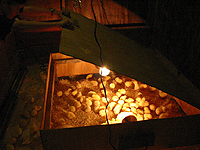 producing eggs while she continues to incubate them,
carefully turning them and keeping them just the right
temperature and humidity for about three weeks. We
have a broody hen now and can't wait to see her
leading around her baby chicks. After about 21 days,
the chicks will begin peeping inside their shell.
There is a small air sack inside each egg that helps
to get them started. The chicks then begin the long
arduous task of pipping to break out of the shell.
It's wonderful to watch and can take up to a full 24
hours!
producing eggs while she continues to incubate them,
carefully turning them and keeping them just the right
temperature and humidity for about three weeks. We
have a broody hen now and can't wait to see her
leading around her baby chicks. After about 21 days,
the chicks will begin peeping inside their shell.
There is a small air sack inside each egg that helps
to get them started. The chicks then begin the long
arduous task of pipping to break out of the shell.
It's wonderful to watch and can take up to a full 24
hours!
|